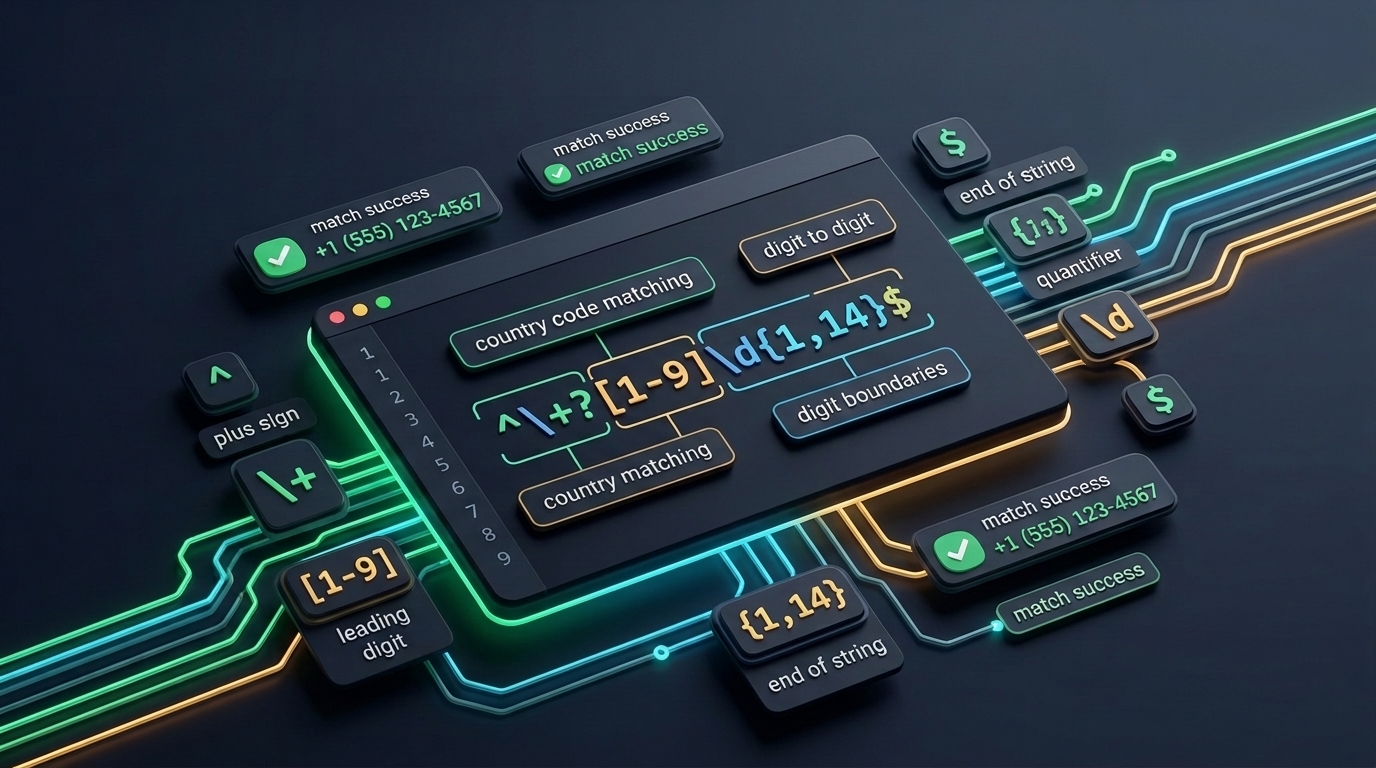
Phone Number Regex Guide
Master regular expressions for telephone number pattern matching, syntax checking, international prefixes, and combining regex with parsing libraries.
Generate random, realistic phone numbers for testing, development, and design. Pick a country, choose a format, and generate valid example numbers instantly.
Common applications across testing, privacy, demos, and design.
Random phone numbers serve a wide range of purposes across software development, privacy, education, and business operations. Here are the most common ways people use generated phone numbers:
Understand country codes, prefixes, digit lengths, and regulatory test ranges.
US phone numbers follow the North American Numbering Plan (NANP). The 3-digit area code identifies the geographic region, the 3-digit prefix narrows the local exchange, and the 4-digit line number identifies the subscriber. The 555 prefix is reserved by the Federal Communications Commission (FCC) for fictional use in media and testing.
UK phone numbers are regulated by Ofcom. Mobile numbers start with 07, landlines with geographic area codes (020 for London, 0121 for Birmingham). The 7700 900xxx range is reserved for use in TV, film, and testing.
Canada shares the +1 country code with the United States under the North American Numbering Plan (NANP). Canadian area codes include 416 (Toronto), 604 (Vancouver), 514 (Montreal), and 403 (Calgary). The 555 prefix reservation applies across all NANP countries.
Australian phone numbers use single-digit area codes: 2 (New South Wales), 3 (Victoria), 7 (Queensland), and 8 (Western Australia/South Australia). Mobile numbers start with 04. The Australian Communications and Media Authority (ACMA) oversees number allocation.
German phone numbers have variable length. Area codes range from 2 digits (30 for Berlin, 89 for Munich) to 5 digits for smaller towns. Mobile numbers start with 015x, 016x, or 017x. Bundesnetzagentur (BNetzA) manages the German numbering plan.
French phone numbers use a 2-digit grouping system after the region code. Region 1 covers Paris and Île-de-France. Mobile numbers start with 06 or 07. ARCEP (Autorité de régulation des communications électroniques et des postes) regulates French telecommunications.
Indian mobile phone numbers are 10 digits long and start with 6, 7, 8, or 9. The Telecom Regulatory Authority of India (TRAI) manages the numbering plan. Major mobile operators include Jio, Airtel, and Vi (Vodafone Idea). Landline numbers include a 2–4 digit area code.
Pakistani mobile numbers use 3-digit network codes: 300–304 (Jazz/Mobilink), 310–315 (Zong), 320–323 (Jazz), 330–338 (Ufone), and 340–349 (Telenor). The Pakistan Telecommunication Authority (PTA) oversees number allocation and regulation.
Know when to use test numbers versus real communication services.
Best practices for ethical use of generated test data.
Follow a number from test generation to validation and sharing. Every tool runs directly in your browser.
Common questions about the phone number generator.
An online tool that creates random, correctly formatted example phone numbers for testing, development, and design.
No, generated numbers use reserved test ranges and have no SIM, network, or owner.
Yes, pick from the US, UK, Canada, Australia, Germany, France, India, or Pakistan.
No, they are formatted strings with no network connection, so no calls or SMS.
Yes, reserved test ranges keep them safe for QA, database seeding, and automated tests.
To seed test databases and validate phone inputs without using real customer data.
Yes, 8 countries, with both international and local formatting options.
No, OTP needs an active line, so use a service like Twilio or Plivo.
No, test ranges and random digits are designed to avoid real, active numbers.
Yes, they are ideal for prototypes, CRM demos, scripts, and onscreen displays.
Never use them for spam, fraud, harassment, or any illegal activity.
Explore technical articles on telecom formatting, regex validation, database storage, and QA testing best practices.
Master regular expressions for telephone number pattern matching, syntax checking, international prefixes, and combining regex with parsing libraries.

Best practices for database schema design, VARCHAR column selection, E.164 normalization, extensions handling, and personal data encryption.

Learn how to generate large-scale synthetic phone number datasets for load testing, database seeding, performance benchmarks, and QA suites.